Therapeutic Thresholds: The Percentages That Actually Matter
There's a percentage at which an ingredient starts working — and a percentage below which you're essentially paying for hope.
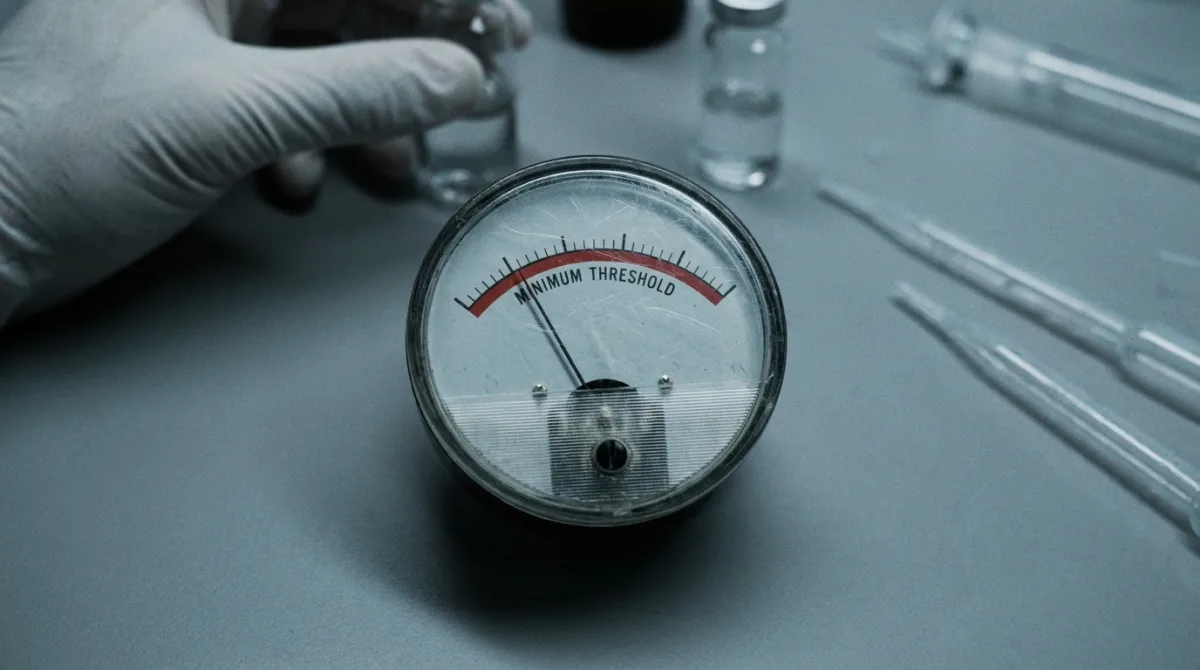
There’s a percentage at which an ingredient starts working — and a percentage below which you’re essentially paying for hope. The skincare industry is built on the gap between those two numbers.
The Uncomfortable Maths
Every active ingredient has a therapeutic threshold — the minimum concentration at which peer-reviewed research shows it actually does something. Below that threshold, you’re applying an ingredient. Above it, you’re applying a treatment.
The problem is that most products don’t tell you which side of the line they’re on. “Contains vitamin C” could mean 15% (proven effective) or 0.5% (basically nothing). The label looks identical. The price might be identical. The result won’t be.
Here’s what the research actually shows for the ingredients that matter most.
Vitamin C (L-Ascorbic Acid)
Therapeutic threshold: 10–20%
The foundational research from Duke University — the studies that launched the entire topical vitamin C category — used concentrations between 10% and 20%. Below 10%, the antioxidant effect is present but minimal. Above 20%, you get more irritation without proportionally more benefit.
The sweet spot for most skin types is 15–20%. At these levels, you get meaningful collagen synthesis stimulation, photoprotection enhancement, and visible brightening.
What you’ll often find: Products claiming “vitamin C” with 0.5–5% — technically true, functionally useless for anything beyond basic antioxidant presence. Some brands use vitamin C derivatives (ascorbyl glucoside, sodium ascorbyl phosphate) which are more stable but require higher concentrations for equivalent effect — and rarely contain them.
Retinol
Therapeutic threshold: 0.025–1%
Retinol is unusual because it works at genuinely low concentrations — but there’s still a floor. Studies showing wrinkle reduction and collagen stimulation typically use 0.025% to 1%. The percentage that works for you depends on tolerance, not marketing.
At 0.025–0.05%, you get mild cellular turnover with minimal irritation — appropriate for beginners or sensitive skin. At 0.5–1%, you’re in the range used in clinical trials demonstrating significant anti-aging effects.
What you’ll often find: Retinol “complexes” where the headline percentage refers to a trademarked proprietary blend, not pure retinol. A “2% retinol complex” might contain 0.1% actual retinol and 1.9% of supporting ingredients. Legally accurate. Practically deceptive.
Niacinamide (Vitamin B3)
Therapeutic threshold: 2–5%
Research shows niacinamide works at surprisingly accessible concentrations. At 2%, you see barrier function improvement. At 4–5%, you get the sebum regulation, pore appearance reduction, and anti-inflammatory benefits the ingredient is known for.
Higher isn’t necessarily better here. Some studies suggest 10% doesn’t outperform 5% for most outcomes, and higher concentrations can cause flushing in sensitive individuals.
What you’ll often find: This is one ingredient where mainstream products often hit therapeutic levels. Niacinamide is cheap, stable, and well-tolerated — so brands include it at effective concentrations. The 10% products flooding the market may actually be overkill.
AHAs (Glycolic, Lactic, Mandelic Acid)
Therapeutic threshold: 5–12% (depending on acid and pH)
Alpha hydroxy acids need both adequate concentration AND appropriate pH to exfoliate. This is where brands play the most games.
Glycolic acid — the smallest molecule and most penetrating — shows efficacy starting around 5% at pH 3.5–4. At 8–12%, you’re in the range of significant exfoliation and collagen stimulation. Above 12% enters professional peel territory.
Lactic acid is gentler and needs 5–10% for comparable effects. Mandelic acid, larger still, typically requires 10%+ for meaningful results.
What you’ll often find: Products with adequate acid percentage but formulated at pH 5+ — where the acid is largely neutralised and functions as a mild humectant rather than an exfoliant. Or low concentrations (1–3%) marketed as “gentle” when they’re really just ineffective.
Hyaluronic Acid
Therapeutic threshold: 0.1–2%
Hyaluronic acid is a hydrator, not an active treatment — but there’s still a threshold. Studies show skin hydration benefits from concentrations as low as 0.1%, with diminishing returns above 2%. More isn’t better; it can actually create a tacky, pilling formula.
The molecular weight question is more nuanced than marketing suggests. Lower molecular weight HA penetrates deeper; higher molecular weight stays on the surface and films. Neither is inherently superior — they do different things.
What you’ll often find: “Multi-weight” hyaluronic acid claims used to justify premium pricing on formulas that may contain perfectly effective but unremarkable 0.5% HA. The molecular weight theatre distracts from the fact that basic HA at basic concentrations works fine.
Salicylic Acid (BHA)
Therapeutic threshold: 0.5–2%
The only common BHA has a narrow effective range. At 0.5%, you get mild comedone reduction suitable for maintenance. At 2% — the maximum allowed in UK/EU leave-on products — you’re at full clinical strength.
Unlike AHAs, salicylic acid is oil-soluble, meaning it penetrates into pores rather than working on the surface. This makes it particularly effective for acne-prone skin at concentrations that seem low compared to glycolic.
What you’ll often find: This is actually one area where regulation helps consumers. The 2% cap means most salicylic products are at or near maximum potency. The game here is more about vehicle and pH than about underdosing.
Azelaic Acid
Therapeutic threshold: 10–20%
Clinical studies for hyperpigmentation and rosacea use azelaic acid at 15–20%. Prescription formulas in the UK are typically 15% (Skinoren) or 20% (Finacea). Below 10%, evidence for efficacy drops significantly.
This creates a genuine gap in the cosmetic market. UK regulations limit cosmetic azelaic acid to 10%, meaning over-the-counter products max out below the concentration proven most effective in research.
What you’ll often find: 10% azelaic acid products positioned as prescription-equivalent when they’re actually at the regulatory ceiling, not the clinical optimum. Still useful — just not the same as prescription strength.
Peptides
Therapeutic threshold: Varies wildly (often proprietary)
Here’s where it gets murky. Different peptides have different effective concentrations, and much of the research is manufacturer-funded with unpublished methodologies. Matrixyl (palmitoyl pentapeptide-4) has some independent validation at around 4–8 ppm; argireline (acetyl hexapeptide-3) shows effects in studies using 5–10%.
The problem is that most products don’t disclose peptide concentrations at all. “Contains peptides” could mean therapeutic levels or trace amounts for label appeal. Without disclosure, you’re trusting the brand.
What you’ll often find: Peptide serums listing multiple peptides — impressive on the label, impossible to evaluate. Are any at effective levels? Are they all at trace levels so the brand can claim a “peptide complex”? No way to know.
Why Brands Don’t Tell You
Formulation protection. Legitimate concern. If you’ve spent years developing an effective formula, you don’t want competitors copying it. This is trade secret, not deception.
Marketing flexibility. Less legitimate. If you don’t commit to percentages, you can reformulate without telling anyone. Costs go up? Quietly reduce the vitamin C. Nobody knows.
Underdosing concealment. The cynical case. If your “vitamin C serum” contains 2% vitamin C, you’d rather not invite comparison with products containing 15%. Silence protects the illusion.
The first reason is fair. The second and third are why percentage claims — when brands actually make them — are worth paying attention to.
What This Means For You
You don’t need exact percentages for every ingredient. But for the actives you’re actually using for a purpose — vitamin C for brightening, retinol for anti-aging, AHAs for exfoliation — you should know whether you’re at therapeutic levels.
Look for brands that disclose. If a company tells you their vitamin C is 15%, their niacinamide is 5%, their retinol is 0.5% — they’re inviting scrutiny. That’s confidence in their formulation.
Be sceptical of vague claims. “High-potency vitamin C” means nothing. “Clinical-strength retinol” means nothing. These are marketing words that avoid commitment.
Check ingredient position. Ingredients are listed by concentration. If the active you’re buying the product for is listed after fragrance, preservatives, or obscure stabilisers — it’s probably not at therapeutic levels.
Understand what you’re asking for. Higher percentages aren’t always better. They’re also not always tolerated. The goal is therapeutic — enough to work — not maximum possible.
Ask the brand for the percentage. If they give you a straight answer, check it against the ranges above. If they dodge the question, you’ve already got your answer.