Peptides in Skincare: The Trend Outrunning Its Own Evidence
Peptides are 2026's hero ingredient — but a meta-analysis of 19 trials found only modest effects, and independent studies diverge sharply from industry-funded ones. What the science actually supports.
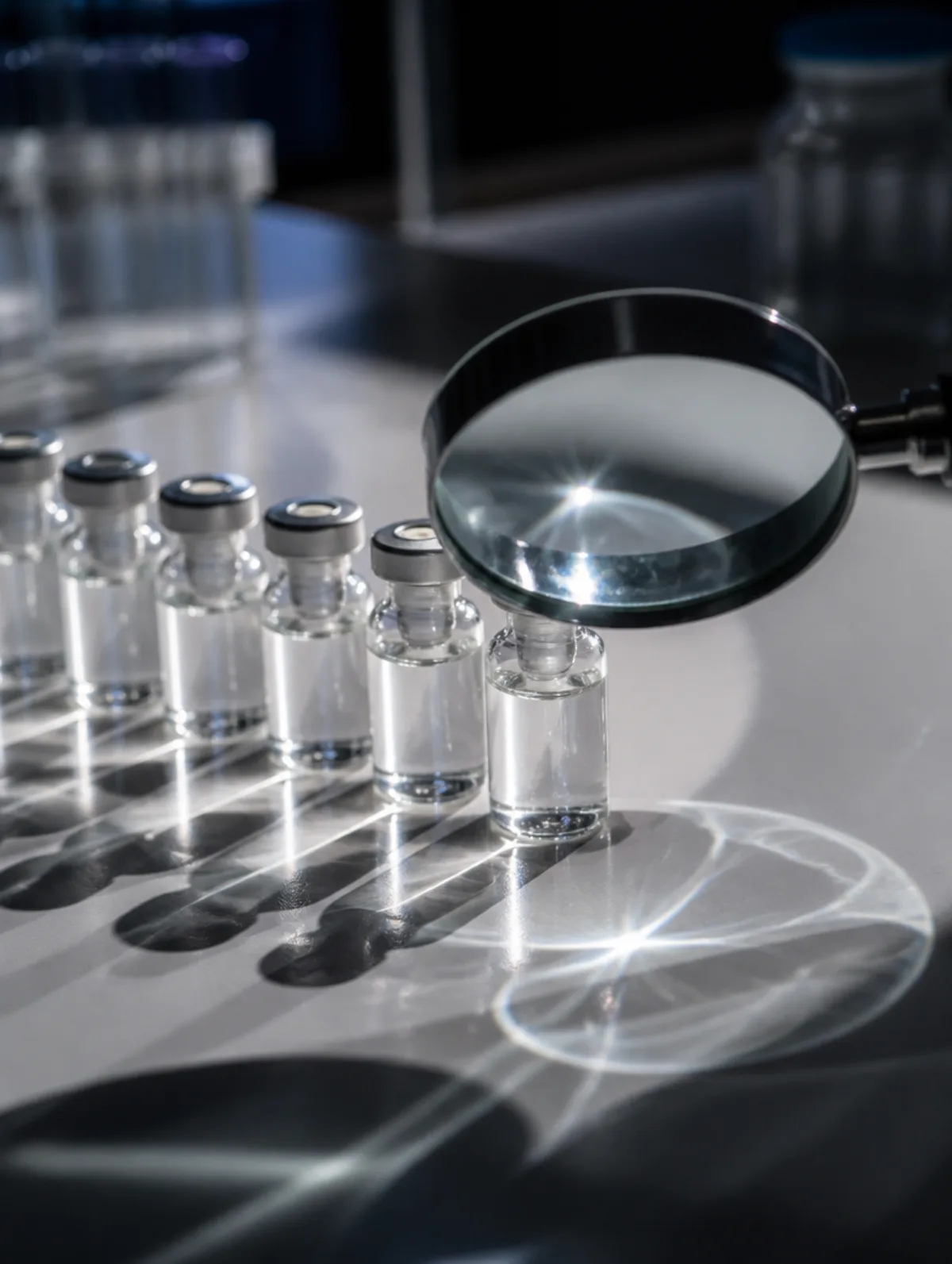
Every few years, the skincare industry finds a molecule it can collectively agree to get excited about. In 2026, that molecule — or rather, that class of molecules — is peptides. They appear in serums, moisturisers, eye creams, and marketing copy with equal enthusiasm. The word “peptide” has become shorthand for “science-backed,” which is precisely the kind of shorthand worth interrogating.
What Peptides Actually Are (and Aren’t)
A peptide is a short chain of amino acids — typically between two and fifty. Longer chains become proteins. Collagen, for instance, is a protein. The theory behind topical peptides is straightforward: apply signal peptides to the skin, and they’ll prompt your cells to produce more collagen, elastin, or other structural proteins. The theory is not the problem. The problem is what happens between the theory and your bathroom shelf.
Peptides are relatively large molecules, and the skin’s entire evolutionary purpose is to keep large molecules out. The stratum corneum — the outermost layer — is a formidable barrier. Some peptides have been modified with lipophilic tails (palmitoylation, for example) to improve penetration, and these modifications do help. But “help” and “solve” are different verbs. A palmitoylated peptide penetrating the outer skin layers is not the same as that peptide reaching the dermal fibroblasts where collagen synthesis actually occurs.
This is the first gap between claim and reality. Every product containing peptides implies skin penetration. Few acknowledge the difficulty of achieving it.
The Evidence: A Closer Look at Who’s Paying
Not all peptides are created equal, and not all studies are either.
Three peptides have earned genuine independent support. GHK-Cu (copper tripeptide-1) showed a 28% average collagen increase over three months in an IRB-approved human trial. Matrixyl 3000, at a 3% concentration, reduced wrinkle depth by roughly 20% after eight weeks in a double-blind RCT with histological confirmation. Argireline, at 10%, cut periorbital wrinkle depth by around 27–30% in 30 days in controlled studies.
Those are real numbers from real trials. They also represent three specific peptides at specific concentrations — not “peptides” as a category.
Here is where the picture gets complicated. A 2026 systematic review and meta-analysis pooled 19 randomised controlled trials involving 1,341 participants. The overall finding was modest. When a separate 2025 meta-analysis in the American Journal of Medicine examined 23 trials and stratified by funding source, the results diverged sharply: industry-funded trials showed statistically significant benefits. Independent and higher-quality trials showed no significant improvement in hydration, elasticity, or wrinkle depth. That is a pattern anyone familiar with industry-funded research will recognise immediately.
This doesn’t mean peptides are inert. It means the confidence with which they’re marketed far exceeds the confidence the independent evidence supports.
The Concentration Problem
Even granting that certain peptides work at certain concentrations, most commercial products don’t disclose what concentration they use. The ingredient list tells you what’s in the bottle. It does not tell you how much. A serum can list “palmitoyl tripeptide-1” and contain it at 0.001% — a fraction of the concentration used in any published trial.
This is a familiar pattern on this site. The same dynamic driving underdosed active ingredients across the industry applies with particular force to peptides, because peptides are expensive raw materials. A product containing GHK-Cu at the studied concentration costs significantly more to manufacture than one containing a trace amount. Both can put “copper peptide” on the label. Only one has any basis for claiming efficacy.
The therapeutic threshold — the minimum concentration at which an ingredient produces a measurable biological effect — is rarely discussed in peptide marketing. What gets discussed instead is the mechanism of action: signal peptides tell your skin to produce collagen! That statement can be simultaneously true at a molecular level and irrelevant at the concentration in your moisturiser.
What This Means in Practice
Peptides are not a scam. That framing would be as reductive as the marketing it criticises. GHK-Cu, Matrixyl, and Argireline have credible data behind them when used at studied concentrations. The problem is the distance between those three well-evidenced peptides and the dozens of proprietary peptide complexes now appearing across the market with names designed to sound clinical and evidence trails that, on inspection, consist of a single supplier-funded in-vitro study.
A January 2026 review from Tufts University concluded that even oral collagen peptide supplements — which bypass the skin-penetration problem entirely — are “not currently recommended to treat skin aging.” If swallowing peptides in capsule form produces debatable results, the burden of proof on rubbing them into the surface of your skin in an unspecified concentration should be proportionally higher. Most brands treat it as proportionally lower.
The marketing works because the underlying science is genuinely interesting. Peptides do participate in cell signalling. The biology is real. But cosmetic formulation is not a biology lecture — it is a commercial exercise in which the most fascinating mechanism of action is worth precisely nothing if the molecule cannot reach its target at a sufficient dose. What the industry sells is the fascination. What it often delivers is the hero ingredient at a homeopathic dose.
If you’re considering a peptide product, the useful questions are specific ones. Which peptide? At what concentration? Is that concentration supported by an independent (not supplier-funded) trial? Most brands will not answer the second question, and that silence tells you more than any percentage on the label.