Collagen Supplements for Skin: What 8,000 Trial Participants Actually Show
Collagen drinks, powders and pills promise younger-looking skin. Two landmark reviews tell a more complicated story — especially when you check who funded the research.
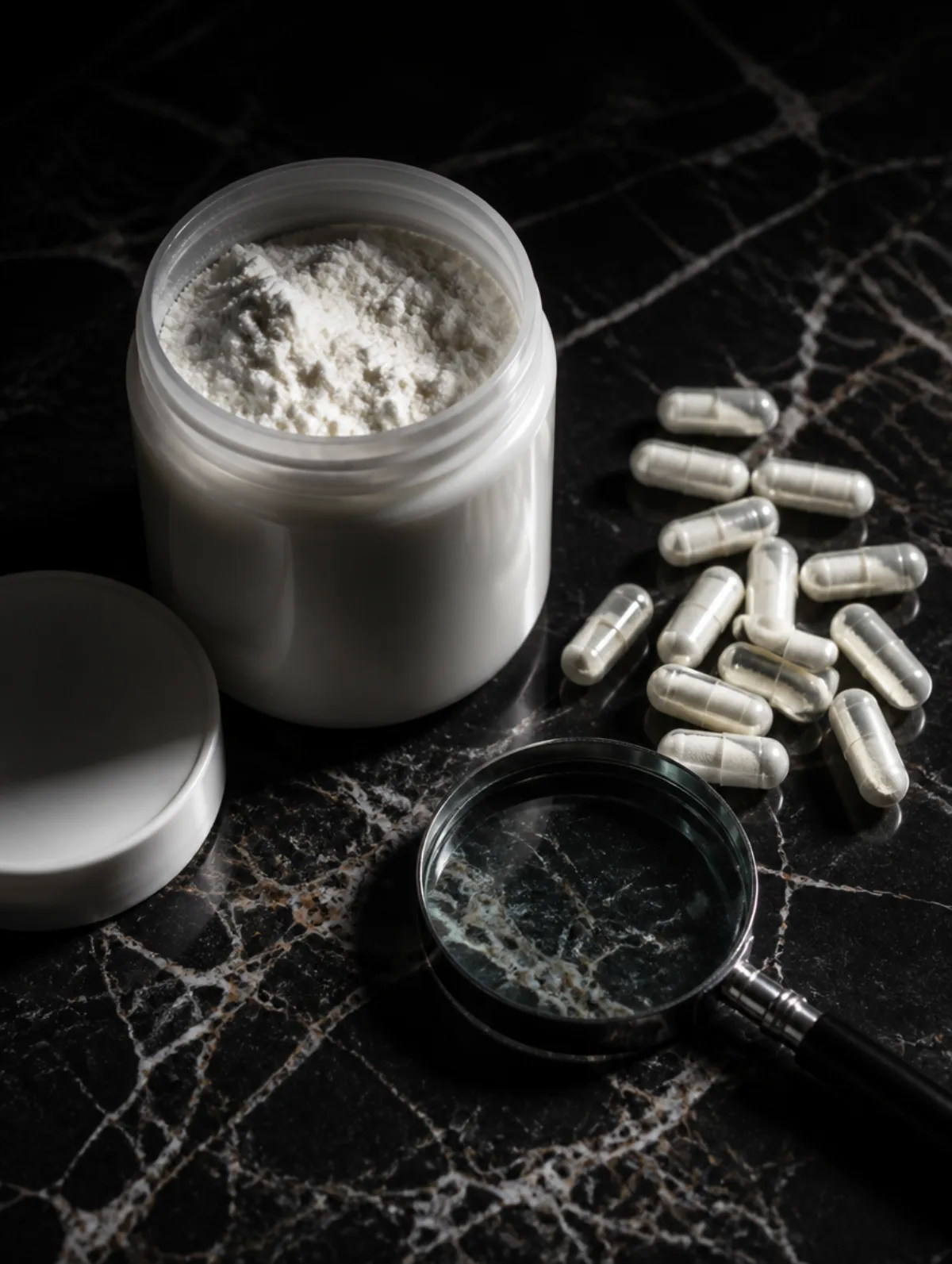
Walk into any chemist or health-food shop in Britain and you’ll find an entire shelf dedicated to ingestible collagen — powders, drinks, capsules, gummies. The packaging is confident. “Clinically proven.” “Visible results in weeks.” “Science-backed beauty from within.”
The market for these products has roughly doubled since 2021. The question that ought to follow that growth is straightforward: does swallowing collagen actually change your skin?
I spent a decade formulating cosmetics. I’ve already written about why rubbing collagen on your face does nothing meaningful — the molecule is far too large to cross the skin barrier. Supplements sidestep that problem entirely. You swallow hydrolysed collagen peptides, they’re absorbed in the gut, and the theory is that those peptide fragments signal your fibroblasts to produce more collagen in the dermis. It is, at least, a biologically plausible mechanism. That alone puts it ahead of most things I investigate on this site.
But plausible is not the same as proven. And when you look closely at who’s generating the evidence, the picture gets considerably less comfortable.
The Funding Problem No One Talks About
In May 2025, a systematic review in The American Journal of Medicine pooled data from 23 randomised controlled trials — 1,474 participants. On first glance, the results looked favourable: collagen supplementation appeared to improve hydration, elasticity and wrinkle depth.
Then the authors did something most supplement marketing hopes you’ll never notice. They stratified the results by funding source.
Industry-funded trials consistently showed statistically significant benefits. Independently funded trials did not. The review’s conclusion was blunt: there is currently no clinical evidence to support the use of collagen supplements to prevent or treat skin ageing. Not “insufficient evidence.” No evidence — once you strip out the research paid for by the companies selling the product.
This is the pattern I keep returning to across clinical studies on this site. The finding isn’t that companies fabricate data. It’s subtler. Industry-funded trials tend to use smaller sample sizes, shorter durations, less rigorous controls, and outcome measures that favour the product. Each choice is defensible in isolation. Together, they tilt the playing field.
What the Largest Review Actually Found
In February 2026, a team at Anglia Ruskin University published what is currently the most comprehensive analysis: an umbrella review covering 16 meta-analyses, 113 randomised controlled trials and nearly 8,000 participants. It received no supplement-industry funding.
Their findings were more nuanced than a flat “doesn’t work,” but they were a long way from what the packaging claims:
- Skin elasticity and hydration showed modest improvements.
- Wrinkle reduction — the outcome most supplements lead with in their marketing — was not supported.
- Benefits only appeared with consistent use over several months, not the “visible results in weeks” that labels promise.
- Skin roughness showed no improvement at all.
Put plainly: if you take hydrolysed collagen peptides daily for three to six months, your skin may become slightly more hydrated and marginally more elastic. It will not look noticeably younger. Your wrinkles will not diminish. The effects, where they exist, are modest enough that you’d struggle to see them without clinical measurement instruments.
That is a defensible scientific finding. It is also nothing like the transformation that the marketing implies.
The Digestion Question
There’s a more fundamental issue that supplement marketing glosses over entirely. When you swallow collagen — hydrolysed or otherwise — your digestive system breaks it down into amino acids and small peptides. That’s what digestion does. Your body doesn’t receive the collagen and politely route it to your face.
Those amino acids enter the general pool of amino acids from everything else you eat. Your body uses them wherever it needs them — muscles, joints, organs, connective tissue. The idea that swallowed collagen peptides preferentially accumulate in the dermis requires a mechanism that hasn’t been convincingly demonstrated in humans.
Some proponents argue that specific dipeptides like hydroxyproline-glycine survive digestion and act as signalling molecules for fibroblasts. There is early-stage research suggesting this is possible. But “possible” and “reliably happens at meaningful concentrations from a daily sachet” are different claims, and the second one hasn’t been established.
The Price of a Protein
Collagen supplements are, chemically, protein. Hydrolysed collagen is protein that has been partially broken down — the same thing your stomach would do anyway. The amino acid profile is dominated by glycine, proline and hydroxyproline, all of which are abundant in ordinary dietary protein from meat, fish and bone broth.
A month’s supply of a branded collagen powder typically costs £25 to £60. A month’s worth of the same amino acids from dietary protein costs a fraction of that. The premium you pay is for the packaging, the branding and the implication that this particular protein source has skin-specific benefits that chicken or fish cannot provide. The evidence for that specificity is thin.
This mirrors the pattern I’ve documented with peptides in skincare — a biologically interesting mechanism is identified, early research is promising, and the supplement or cosmetics industry scales the marketing far beyond what the data supports. The trend outruns the evidence, and by the time larger, better-designed studies arrive, the market is already established and the narrative is entrenched.
What This Means for You
Collagen supplements are not dangerous. They’re protein. If you take them and feel your skin is better, you may be right — or you may be experiencing the well-documented placebo effect of any daily wellness ritual, combined with increased overall protein intake and the hydration that usually accompanies it (most collagen protocols involve mixing powder into water or drinking a liquid supplement).
The honest summary is this: the largest independent review of the evidence found conditional, modest effects on hydration and elasticity, no effect on wrinkles, and benefits only after months of consistent use. That’s not nothing — but it is a very long way from the “up to” results claims on the box.
If a supplement brand told you “take this daily for six months and your skin may become slightly more hydrated, as measured by a corneometer, though you probably won’t notice visually” — would you pay £40 a month for it?
That’s the question the marketing is designed to stop you asking.