Niacinamide in Everything: Why 5% Works and 10% Sells
Niacinamide went from evidence-based niche active to the most-used cosmetic ingredient of the decade. Studies support it at 2–5%. Brands sell it at 10–20%. Your bathroom cabinet probably contains three products with it already.
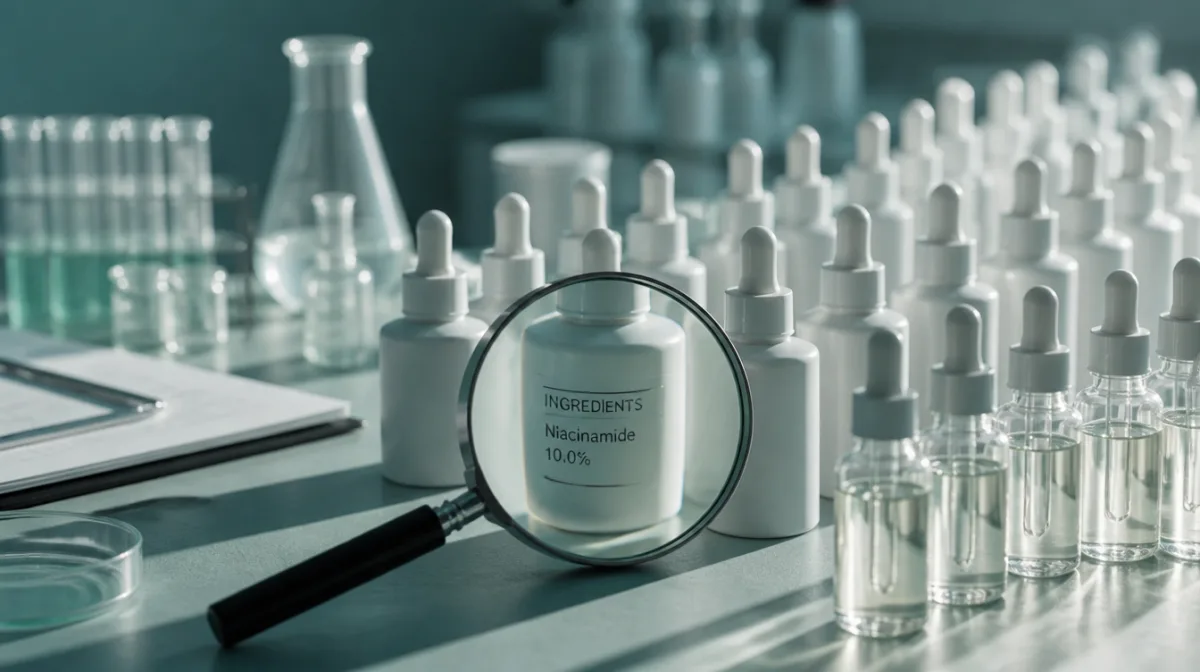
Niacinamide has completed one of the more remarkable journeys in skincare marketing. A decade ago it was a quiet, unsexy B vitamin derivative that appeared in a handful of mid-range moisturisers. Today it is the single most prescribed cosmetic active of the 2020s, found in over sixty per cent of dermatologist-recommended moisturisers, forty per cent of over-the-counter serums, and — for reasons that test the imagination — toothpaste.
The ingredient works. That much is not in dispute. What deserves scrutiny is everything that happened after the first positive studies: the concentration wars, the addition to products where it serves no purpose, and the quiet epidemic of irritation in people who don’t realise they’re applying three times the studied dose across a morning routine.
What the research actually supports
The clinical evidence for niacinamide is decent — better, in fact, than for many trendy ingredients that end up under scrutiny on this site. Pooled data from eighteen randomised controlled trials shows genuine effects on skin barrier function, sebum regulation, and gradual improvement in hyperpigmentation. Serious adverse events are essentially absent at the studied concentrations.
Those studied concentrations are the key detail. The bulk of the positive evidence comes from formulations at 2% to 5%. A 4% niacinamide cream showed statistically significant improvements in hyperpigmentation relative to vehicle in one of the most-cited trials. A 5% formulation, combined with daily sunscreen, produced measurable brightening over twelve weeks. The research is solid. The research is also specific about dose.
What it does not show is that 10% is twice as good as 5%, or that 20% is four times as good. Above 5%, the evidence thins out considerably, and what data does exist suggests diminishing returns rather than linear improvement. The dose-response curve flattens. The irritation curve does not.
The concentration arms race
If 5% is supported and 10% sells better, the commercial logic writes itself. The market is now saturated with formulations at 10%, 15%, even 20% niacinamide — concentrations that exist because consumers have been trained to believe higher numbers mean stronger results. This is the same instinct that drives the underdosed actives problem from the opposite direction: too little is pointless, so the industry overcorrects to too much and calls it premium.
A brief scan of ingredient lists on any high-street shelf reveals niacinamide in serums, moisturisers, toners, cleansers, eye creams, body lotions, hand creams, and lip balms. It now appears in hair products and oral care. The pattern is not driven by evidence that niacinamide improves dental health or hair follicle function in topical application. It is driven by the fact that the ingredient is cheap to formulate with, consumers recognise the name, and listing it on the front of the packaging moves units.
This is how a hero ingredient is manufactured — not through scientific consensus, but through marketing repetition until the name itself becomes a purchase trigger. The difference with niacinamide is that the ingredient genuinely delivers at the right dose. The industry’s response has been to ensure the right dose is almost impossible to stick to.
The stacking problem nobody warns you about
Here is the practical consequence of putting niacinamide in every product category: a consumer using a niacinamide serum, a niacinamide moisturiser, and a niacinamide SPF — a perfectly normal three-step routine, modest by the standards of the multi-product model the industry promotes — may be applying a combined concentration of 15% to 25% daily. None of those individual products will cause irritation on their own at the concentrations listed. Together, they create a cumulative dose that no study has tested and no dermatologist would recommend.
The resulting irritation — redness, flushing, a sandpaper texture, breakouts along the jawline — is real and well-documented in dermatological practice. But it gets attributed to “sensitive skin” or a “reaction to another ingredient,” rarely to the simple arithmetic of stacking the same active across a routine. The industry has no incentive to raise this issue. If a consumer drops one niacinamide product because of irritation, the solution they’re sold is a different niacinamide product marketed as gentler.
Dermatologists have started flagging this publicly. The advice — use one product with niacinamide, not four — is sound. It also contradicts the commercial model that put the ingredient into every possible vehicle.
A useful ingredient buried under its own marketing
Niacinamide at 2–5% in a well-formulated moisturiser is a sensible, evidence-backed choice for people dealing with mild hyperpigmentation, excess oil, or compromised barrier function. It is inexpensive, stable, well-tolerated at appropriate doses, and compatible with most other actives. That is a genuine recommendation, not a caveat.
The problem is not the molecule. The problem is an industry that took one good set of data and built a concentration arms race, a category expansion into products where it has no business, and a consumer environment where three-source stacking is the default rather than the exception. The research that made niacinamide worth paying attention to tested it as a single ingredient at a single dose. The market sells it as an ingredient in everything at every dose — and when your skin objects, it sells you a different version of the same thing.