SPF in Makeup: The Protection You're Not Actually Getting
Your foundation says SPF 30. Your powder claims SPF 15. You feel protected. But unless you're applying makeup in quantities nobody actually uses, those numbers mean…
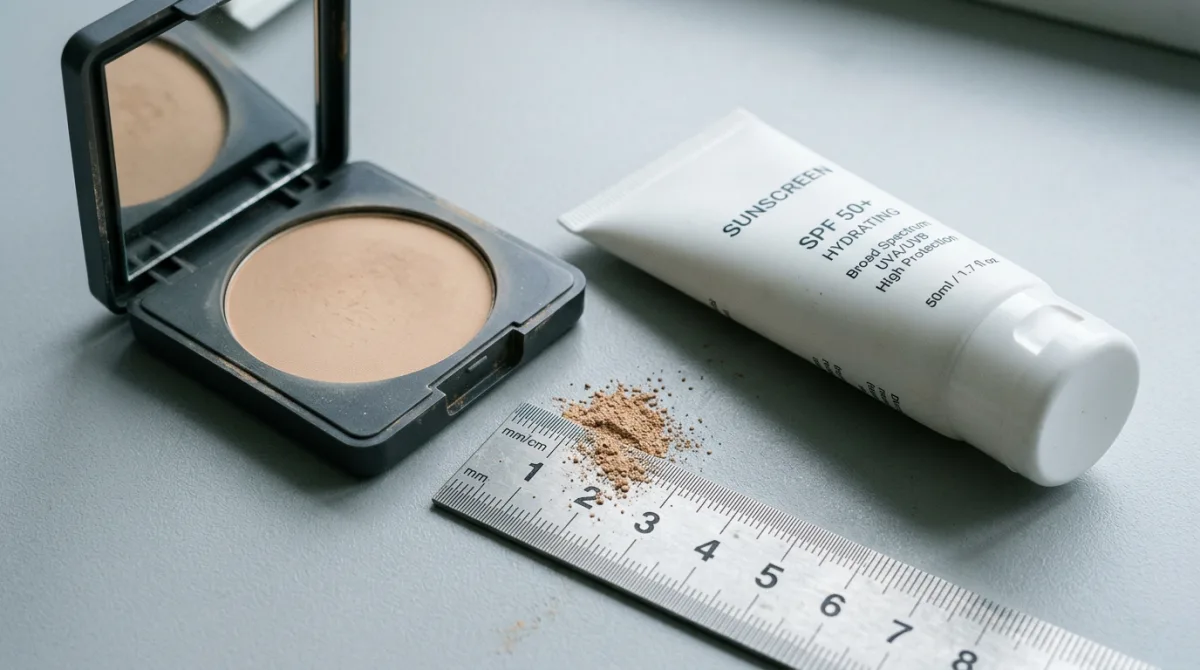
Your foundation says SPF 30. Your powder claims SPF 15. You feel protected. But unless you’re applying makeup in quantities nobody actually uses, those numbers mean almost nothing.
The Application Gap
SPF ratings are tested at a standardised application amount: 2 milligrams of product per square centimetre of skin. For your face, that works out to approximately a quarter teaspoon of product — or about 1.25 millilitres.
To get the SPF 30 claimed on your foundation, you’d need to apply roughly seven times more product than most people actually use. We’re talking about a thick, visible layer — not the sheer, skin-like finish makeup is designed to provide.
Nobody applies foundation like that. Nobody wants to. The product would look terrible, feel heavy, and defeat the entire purpose of natural-looking makeup.
At typical application amounts — around 0.5–1mg/cm² — you’re getting perhaps SPF 2–4. Better than nothing. Nowhere near what the label suggests. It’s the same trick as a hero ingredient present at a homeopathic dose: technically there, functionally absent.
The Maths Nobody Mentions
SPF doesn’t scale linearly with application amount. The relationship is roughly exponential. Half the application doesn’t give you half the SPF — it gives you dramatically less.
Studies have shown that applying sunscreen at half the tested amount results in roughly the square root of the stated SPF. So your SPF 30 foundation at half-application gives you approximately SPF 5. At the quarter-application most people actually use, you’re in SPF 2–3 territory.
The same principle applies to SPF moisturisers, by the way — another product where the tested amount and the applied amount rarely match. Unless you’re applying a full quarter-teaspoon to your face, you’re not getting the stated protection.
The Coverage Illusion
There’s another problem: makeup isn’t applied evenly.
Foundation goes on thicker in some areas and thinner in others. We blend it out. We skip certain zones. We powder over it, disturbing the layer. The result is inconsistent coverage with gaps that leave skin exposed.
Dedicated sunscreen is formulated to spread evenly and form a continuous protective film. Makeup is formulated to blend seamlessly and look invisible. These are contradictory design goals. The same product rarely excels at both.
The Reapplication Problem
Sunscreen needs reapplication every two hours during sun exposure, or after sweating or swimming. That’s the recommendation for proper protection.
Nobody reapplies full makeup every two hours. The concept is absurd. You’d need to remove your existing makeup and start fresh — repeatedly throughout the day.
Even if you’re indoors, UV radiation penetrates windows. Incidental exposure adds up. The single application of SPF makeup you put on at 8am is degraded and ineffective by lunchtime, let alone the afternoon.
Why Brands Do This
Adding SPF to makeup is cheap and creates a powerful marketing angle. “Sun protection built into your makeup routine” sounds convenient. It appeals to consumers who want simplicity.
Brands aren’t technically lying. The SPF rating is real — at the tested application amount, the same way an “up to” headline number is real for whoever achieved it. They’re just not highlighting that the tested amount is impractical for actual use.
The small print usually covers them: “Apply liberally” or “Reapply as directed.” That nobody follows these instructions for makeup isn’t the brand’s legal problem.
What it is: a marketing claim that technically survives regulatory scrutiny — the same low bar that lets “clinically proven” and “dermatologically tested” mean almost nothing — while creating consumer expectations that won’t be met.
The Real Risk
The danger isn’t that SPF makeup exists. It’s that people rely on it as their primary sun protection.
If you think your SPF 30 foundation has you covered, you skip actual sunscreen. You spend more time in the sun than you would otherwise. You accumulate UV damage while believing you’re protected.
UV exposure is cumulative. It doesn’t reset. Every bit of unprotected exposure contributes to long-term skin ageing and skin cancer risk. False confidence in inadequate protection does real harm.
What Actually Works
Apply dedicated sunscreen first. A proper broad-spectrum SPF 30–50 sunscreen as the final step of your skincare routine, before makeup. Apply the full amount — a quarter teaspoon for your face, more for neck and ears.
Let it set. Give sunscreen a few minutes to settle before applying makeup. This improves wear and reduces the chance of makeup disturbing the protective layer.
Think of SPF makeup as bonus, not baseline. If your foundation happens to have SPF, great — it’s an extra layer. But it’s not your protection. It’s not doing the heavy lifting.
Reapply with SPF powder if needed. Mineral SPF powders can help top up protection over makeup during the day. They’re not perfect — application is still uneven — but they’re more practical than reapplying liquid sunscreen over a full face of makeup.
Consider SPF setting sprays critically. These exist, but the same application-amount problem applies. You’d need to drench your face to achieve stated SPF. Light misting gives light protection.
The Texture Objection
The common complaint: “Sunscreen under makeup is greasy, pills, or ruins the finish.” This was more valid a decade ago. Modern sunscreen formulation has improved dramatically.
Lightweight, cosmetically elegant sunscreens exist now — formulas designed specifically to wear well under makeup. They’re not all created equal, so finding one that works with your skin and your makeup routine requires some experimentation. But the options are there.
The alternative — relying on SPF makeup alone — isn’t a texture solution. It’s inadequate protection dressed up as convenience.
The Honest Summary
SPF in makeup provides minimal protection at the amounts people actually apply. It does not replace dedicated sunscreen. It cannot be meaningfully reapplied. It creates false confidence that leads to increased UV damage.
Treat SPF claims on makeup as marketing language, not meaningful protection. Use real sunscreen as your base. Think of any SPF in your foundation or powder as a small bonus on top of proper protection, not a substitute for it.
Your skin doesn’t care what the label says. It only cares how much UV radiation actually reaches it. And with SPF makeup alone, that’s far more than you’ve been led to believe.