Skin Purging vs Breakouts: Industry's Get-Out Clause
Start a new product, break out, and the response is predictable: "It's just purging — push through it." Sometimes that's true.
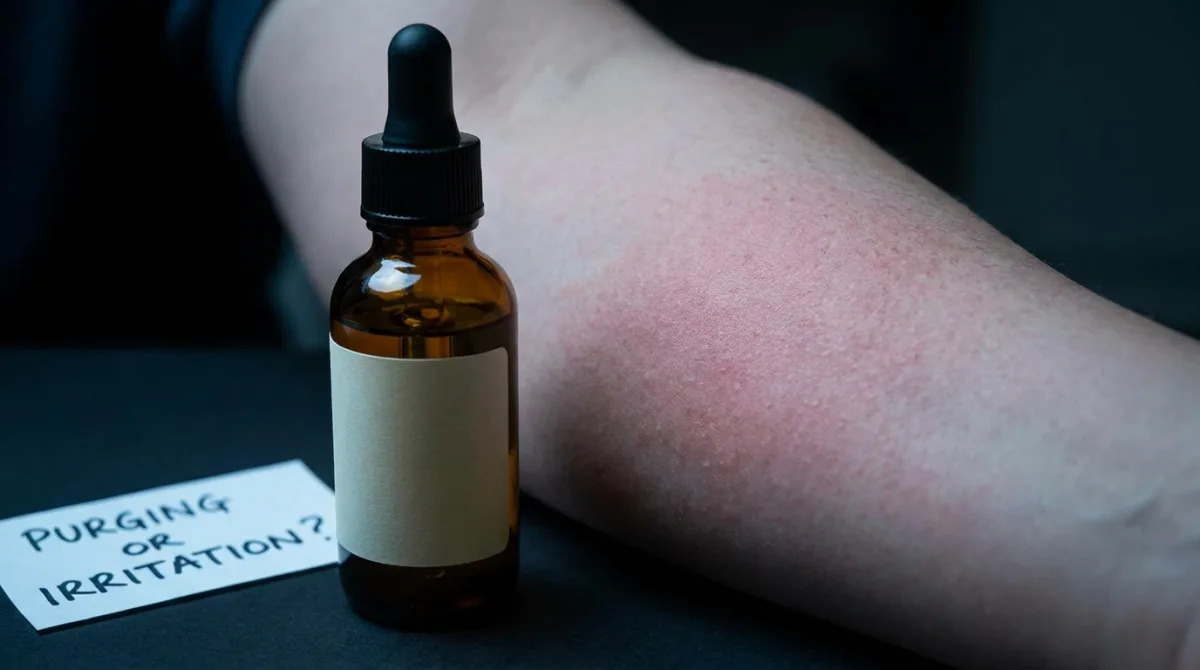
Start a new product, break out, and the response is predictable: “It’s just purging — push through it.” Sometimes that’s true. Often it’s a convenient excuse for a product that’s causing harm. Knowing the difference matters.
What Purging Actually Is
Purging is a real phenomenon. When you introduce certain active ingredients that accelerate cell turnover, existing microcomedones — blockages that were already forming beneath the skin’s surface — get pushed to the surface faster than they would naturally.
Think of it this way: those spots were coming regardless. The product just accelerated the timeline. Instead of emerging over the next six weeks, they emerge over the next two. You’re not creating new problems — you’re fast-forwarding through existing ones.
This means purging can only occur with ingredients that affect cell turnover rate — and only when they’re present at a concentration high enough to actually do that, not just listed on the label. The list is specific: retinoids (retinol, tretinoin, adapalene, retinaldehyde), AHAs (glycolic acid, lactic acid, mandelic acid), BHAs (salicylic acid), azelaic acid, and certain enzyme exfoliants.
That’s it. Those are the categories. If you’re not using one of these ingredients, you’re not purging.
What Breakouts Are
Breakouts — regular acne, irritation-induced spots, comedogenic reactions — happen when something in a product doesn’t agree with your skin. This could be:
Comedogenic ingredients — certain oils, silicones, or emollients that block pores. Different skin types react to different ingredients; what’s fine for one person clogs another — though that genuine variability shouldn’t be stretched into the catch-all excuse it’s often used as when a product simply doesn’t work.
Irritation response — skin reacting to fragrance, essential oils, or other sensitising ingredients with inflammation that manifests as spots.
Barrier disruption — stripping products that damage your moisture barrier, leading to compensatory oil production and subsequent breakouts.
Allergic or sensitisation reactions — your immune system responding to an ingredient it doesn’t tolerate.
None of these are purging. All of these are your skin telling you something is wrong.
How To Tell The Difference
The ingredient test. If the product doesn’t contain a cell-turnover active (retinoid, AHA, BHA, azelaic acid, enzyme exfoliant), it cannot cause purging. Full stop. A new moisturiser, serum without actives, cleanser, or sunscreen cannot make you purge. If you’re breaking out from these products, stop using them.
The location test. Purging typically occurs where you already tend to break out. If you normally get spots on your chin and cheeks, purging will show up on your chin and cheeks. If you’re suddenly getting spots on your forehead when you never do, that’s a reaction, not a purge.
The type and severity test. Purging brings existing blockages to the surface faster, so you’ll see whiteheads, blackheads, and small pustules that are accelerated rather than amplified — not dramatically worse than your normal breakouts. Deep cystic acne, painful nodules, inflamed papules that weren’t already brewing, or skin that’s significantly more inflamed or broken out than it’s ever been, point to a reaction instead.
The timeline test. Purging has a natural endpoint. Since you’re clearing out existing blockages, the process should largely resolve within 4–6 weeks (roughly one skin cycle) — a biological deadline, not the arbitrary four-week window marketing likes to promise. If you’re still breaking out at the same rate after eight weeks, it’s not purging — it’s the product causing ongoing problems.
Why The Myth Persists
“It’s just purging” is incredibly useful for brands and influencers:
It prevents returns. If you’re convinced bad reactions are a necessary phase, you won’t send the product back. You’ll buy more. You’ll push through.
It shields bad products. A formula that causes widespread irritation can hide behind “your skin is adjusting.” By the time customers realise it’s not adjusting, they’ve moved on or blamed themselves.
It creates false believers. Sometimes skin problems resolve on their own — a hormonal cycle passes, stress reduces, diet changes. If this happens while you’re “pushing through” with a product, you credit the product for improvement it didn’t cause.
It exploits the sunk cost fallacy. You’ve already invested money and endured weeks of bad skin. Stopping feels like giving up. “Just a bit longer” keeps you committed.
The Real Retinoid Adjustment
Retinoids deserve special mention because they do cause genuine adjustment periods — but the experience is different from how it’s often described.
When you start a retinoid, you typically experience: dryness, flaking, tightness, and mild redness. This is retinisation — your skin adapting to increased cell turnover. It’s normal and resolves as tolerance builds, usually over 4–12 weeks.
You may also experience mild purging: small spots surfacing in your usual breakout zones. This is the legitimate version — existing microcomedones accelerating to the surface.
What’s not normal: severe cystic acne, widespread inflammation, burning sensations, or reactions that worsen rather than plateau and improve. If this happens, you’ve either started too strong, applied too frequently, or your skin genuinely doesn’t tolerate the specific product.
The solution isn’t always to push through. Sometimes it’s to reduce frequency, buffer with moisturiser, try a gentler formulation — or, if the specific retinoid you’re using genuinely isn’t tolerable, weigh up whether a bakuchiol alternative is worth the trade-off — or accept that particular product isn’t for you.
When To Stop
Stop using a product immediately if:
You’re breaking out from a product that doesn’t contain cell-turnover actives. That’s not purging. It’s a reaction.
Breakouts are appearing in places you don’t normally get spots. Your skin is reacting to something new, not clearing something old.
The breakout is accompanied by burning, stinging, or significant redness. Purging shouldn’t hurt. Irritation does.
Things aren’t improving after six weeks. One full skin cycle is enough time for legitimate purging to largely resolve. Ongoing breakouts mean ongoing problems.
Your skin is worse than it’s ever been. Purging accelerates existing issues — it doesn’t create unprecedented inflammation.
What To Do Instead
If you suspect a product is causing genuine reactions rather than purging:
Stop using it. Not temporarily, not on alternate days. Stop. Let your skin recover. This takes 2–4 weeks of gentle, basic skincare.
Identify the likely culprit. Cross-reference the ingredient list with other products that have caused reactions. Look for common ingredients — particular oils, fragrance compounds, or preservatives.
Introduce new products slowly. One product at a time, with at least two weeks between introductions. This makes it possible to identify what’s causing problems.
Trust your skin. No influencer, brand representative, or online stranger knows your skin better than you do. If something feels wrong, it probably is.
None of the tests above are a diagnosis, and they’re not a substitute for one. If breakouts are severe, cystic, painful, or simply not settling regardless of what you stop using, that’s a reason to see a dermatologist rather than keep running through a checklist — persistent or worsening skin reactions can have causes well beyond a single skincare product.
The Bottom Line
Purging is real but limited. It only happens with a handful of cell-turnover ingredients, in the spots you already break out, on a fixed timeline. Everything else is a reaction — and reactions are your skin telling you to stop.
The skincare industry has turned “purging” into a catch-all excuse for products that don’t work, formulas that irritate, and ingredients that shouldn’t be in contact with your skin. Don’t let convenient terminology keep you using something that’s doing damage.
Your skin breaking out is information. Sometimes that information is “adjustment in progress.” More often, it’s “something is wrong.” Learning to tell the difference protects both your skin and your wallet.