Luxury Packaging vs Product Quality: When You're Buying The Jar
The heavy glass jar, the magnetic closure, the ribbon-tied box — luxury skincare packaging often costs more than what's inside it, and sometimes actively works against the formula's stability.
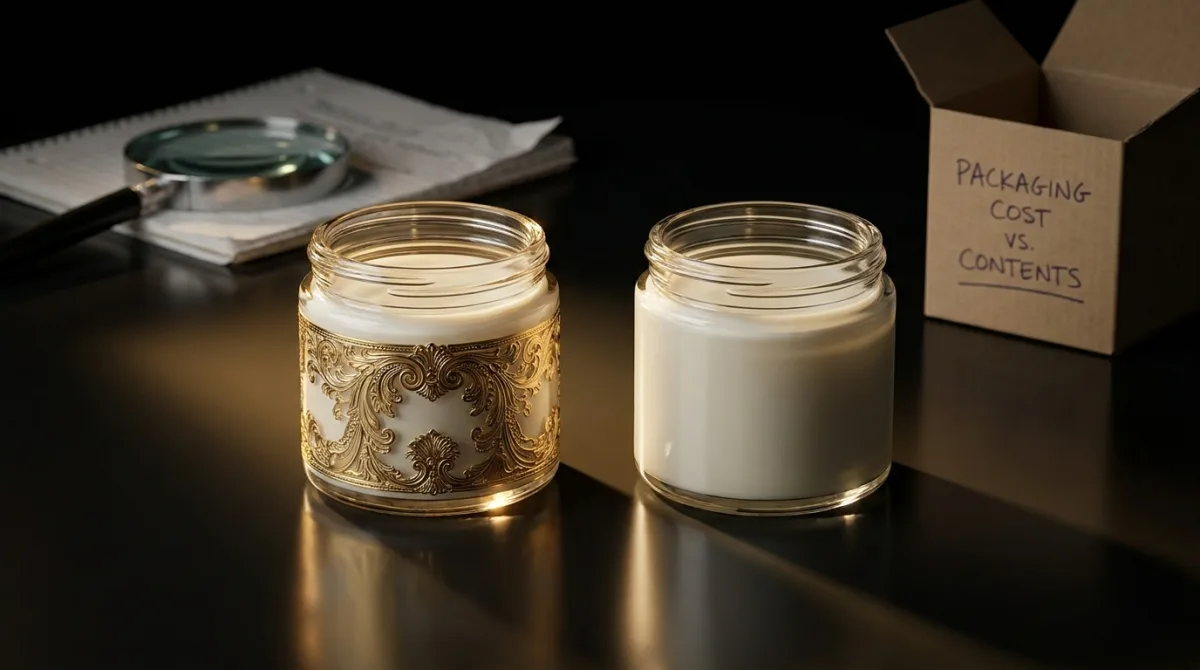
The heavy glass pot. The magnetic closure. The embossed outer box with ribbon pull. Luxury skincare packaging is designed to create an experience before you even touch the product. It also often costs more than what’s inside.
The Economics of Packaging
For many luxury skincare products, packaging represents 30-50% of the total production cost. Sometimes more — a ratio that lines up with where the money actually goes across skincare pricing more broadly.
Consider what goes into a premium skincare presentation: thick glass jar (weight signals quality), inner lid or seal, outer cap with quality closure mechanism, secondary box (often rigid, not folding carton), tissue paper or ribbon, possibly a tertiary shipping box. Each component adds cost.
The actual product — the cream or serum or oil that goes on your face — might represent 20-30% of production cost. Often less. The container you throw away often costs more than the contents you use.
Why Packaging Gets Investment
From a brand perspective, packaging investment makes sense:
First impression. You interact with packaging before you interact with product. Heavy glass and magnetic closures create immediate perception of quality that the product itself must then live up to.
Retail shelf presence. Products compete visually in stores. More impressive packaging captures attention and suggests the product inside is worth premium pricing.
Ritual and experience. Skincare is sold as self-care ritual. Beautiful packaging extends the ritual beyond application — the unboxing, the weight of the jar, the satisfying click of the cap.
Gift-worthiness. Premium packaging makes products feel gift-appropriate. Something in a plastic tube with basic labelling doesn’t feel like a £100 gift, regardless of what’s inside.
Instagram-ability. Products that photograph well get shared. Beautiful packaging is free marketing through customer social posts — the same aesthetic-as-marketing calculation behind the K-Beauty and J-Beauty premium, where pastel packaging and export presentation do as much work as the formula.
None of these reasons relate to product efficacy. Packaging investment is about perception, not performance.
When Packaging Actually Matters
Some packaging choices do affect product quality:
Airless pumps. For oxidation-sensitive ingredients like vitamin C and retinol, airless packaging extends product life and maintains potency. This is functional, not aesthetic.
UV-protective containers. Opaque or amber containers protect light-sensitive ingredients. Clear glass might look beautiful but degrades some actives.
Hygienic dispensing. Pumps and tubes are more hygienic than jars you dip fingers into. Jars expose product to air, bacteria, and contamination with each use.
Here’s the irony: the packaging that actually protects product quality — opaque plastic airless pumps — is often seen as less luxurious than the packaging that compromises it — beautiful clear glass jars with wide openings.
Luxury packaging aesthetics and functional packaging requirements often conflict. Brands choose aesthetics.
The Jar Problem
Open jars are particularly problematic for active skincare:
Every time you open the jar, product is exposed to air and light. Oxidation-sensitive ingredients begin degrading. By the time you reach the bottom of a 50ml jar, the product is months old and has been exposed to air dozens of times.
Dipping fingers introduces bacteria and contaminants. Even with a spatula, the exposed surface area invites microbial growth.
For basic moisturisers without sensitive actives, jars are fine. For products containing vitamin C, retinol, or other stability-sensitive ingredients, jars are actively counterproductive.
Yet jars remain popular in luxury skincare because they feel premium. The heavy glass, the generous opening, the tactile ritual of scooping product — these create experience at the expense of efficacy.
The Weight Illusion
Luxury brands deliberately make packaging heavy. Thick glass, metal components, weighted bases — these add heft that signals value.
Research consistently shows that consumers associate weight with quality. A heavier jar feels more valuable than a lighter one, regardless of contents. Brands exploit this by adding weight for weight’s sake.
This weight has costs: shipping is more expensive, environmental impact is greater, and you’re paying to transport glass that serves no skincare function. The weight is a psychological trick, not a quality indicator.
What You’re Actually Paying For
When you buy a £200 luxury moisturiser:
Perhaps £20-40 is the product itself — ingredients, formulation, manufacturing. Perhaps £30-60 is the packaging — jar, lids, boxes, inserts. Perhaps £20-30 is the retailer margin. Perhaps £80-100 is brand value, marketing, positioning.
The ratios vary, but the principle holds: in luxury skincare, you’re typically paying more for everything around the product than for the product itself — the same logic that inflates serum prices over cream prices despite near-identical manufacturing costs. The packaging you discard may represent more investment than the cream you apply.
Finding Actual Value
Look for functional packaging. Airless pumps, opaque containers, and hygienic dispensing suggest the brand prioritises product integrity over shelf appearance.
Be skeptical of heavy glass. Weight signals nothing about contents. If anything, it signals investment in perception over formulation.
Consider direct-to-consumer brands. Brands selling primarily online often invest less in shelf presence and more in product. They can afford simpler packaging because they’re not competing on retail displays — much like discovering that salon-only “professional” ranges are often identical formulas to retail versions, just repackaged for a different price point.
Evaluate the ingredient list, not the jar. What actives are present? At what concentrations? This matters more than how beautiful the container is.
Accept less glamorous packaging. A serum in a simple plastic bottle with good ingredients might outperform a serum in a crystal-cut glass jar with mediocre formulation. Adjust your expectations about what quality looks like.
The Environmental Note
Luxury packaging also has environmental cost:
Heavy glass requires more energy to produce and transport. Multi-component packaging (glass jar with plastic lid with metal ring) is harder to recycle. Outer boxes, tissue, and secondary packaging become landfill.
If sustainability matters to you, excess luxury packaging conflicts with environmental values. Simpler packaging isn’t just potentially better value — it’s often better for the planet.
The Bottom Line
Luxury skincare packaging is designed to create perceived value through weight, materials, and presentation. It often costs more than the product inside. It sometimes actively compromises product efficacy by exposing sensitive ingredients to air and light.
The packaging you throw away may represent more investment than the cream you apply. The heavy glass jar signals quality but delivers nothing to your skin. The beautiful aesthetic may come at the expense of functional protection.
If you enjoy beautiful packaging as part of your skincare ritual, that’s a valid preference. Just understand what you’re paying for — experience and perception, not necessarily superior formulation. The jar doesn’t go on your face. Only the contents do.