LED Face Masks: Real Science, Underpowered Devices
Clinical phototherapy works. But the LED mask on your bathroom shelf probably doesn't deliver the irradiance that made the science work in the first place.
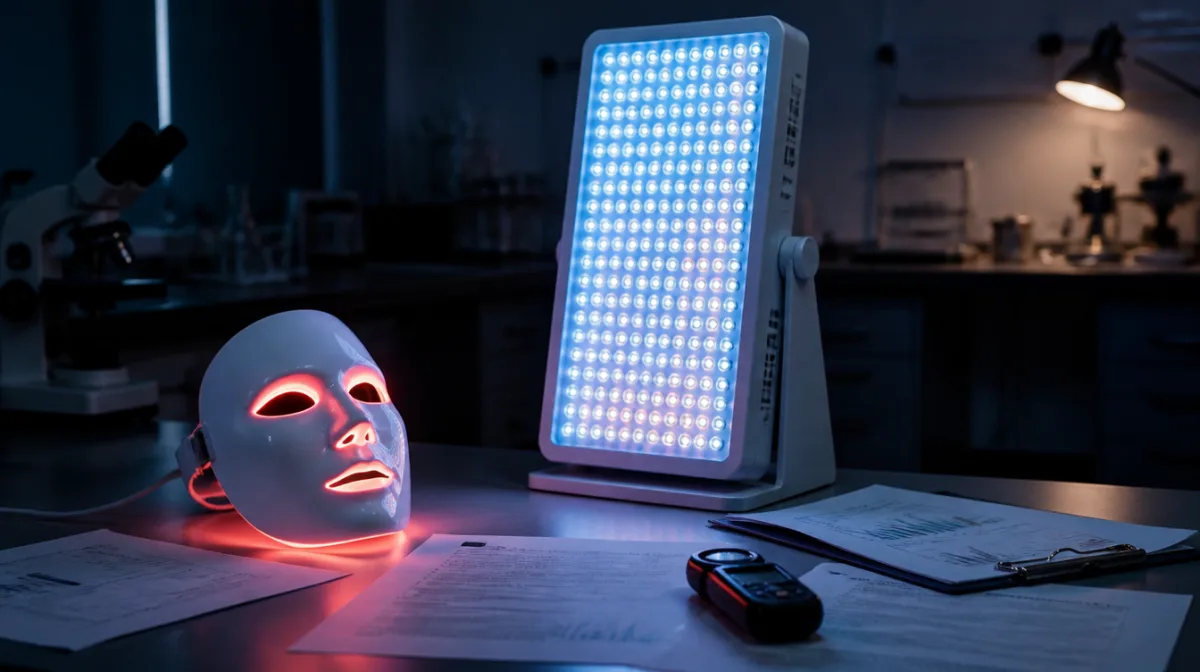
LED face masks are having a moment. They glow from every beauty counter, populate every “best skincare devices” listicle, and have become a fixture of the influencer shelfie. The technology behind them — photobiomodulation — is genuine. Red and near-infrared light at specific wavelengths can stimulate cellular processes in human skin. That part is not disputed.
What is disputed, or rather what should be disputed far more loudly, is whether the device you strap to your face for ten minutes each evening bears any meaningful resemblance to the equipment that produced the clinical results being cited to sell it.
Photobiomodulation is real — at the right dose
The underlying biology is established. Irradiating skin with red light (630–660 nm) and near-infrared light (830–850 nm) triggers mitochondrial responses. Cytochrome c oxidase absorbs photons in these bands, which can increase ATP production and influence downstream signalling cascades involved in collagen synthesis and inflammation. A 2025 randomised, sham-controlled trial demonstrated statistically significant crow’s-feet improvement at 8, 12, and 16 weeks with a home-use device, with independent raters confirming the results. That same year, an international panel of twenty-one dermatologists published a consensus statement in the Journal of the American Academy of Dermatology endorsing photobiomodulation as safe, with measured (not extravagant) support for its efficacy.
So the science exists. The question is whether your mask delivers it.
The irradiance problem nobody talks about
Irradiance is how much light energy reaches each square centimetre of your skin per second, measured in milliwatts per square centimetre (mW/cm²). It is the single most important specification for whether an LED device can do anything biological — and it is the specification most consumer masks either understate, bury in fine print, or simply do not disclose.
Clinical-grade phototherapy devices typically operate at 100 mW/cm² or above. Consumer LED face masks, according to analysis published in Dermatology Times, commonly deliver between 20 and 40 mW/cm². Some budget devices sit even lower. There is no standardised regulatory requirement for manufacturers to verify or publish their irradiance figures on consumer packaging.
This matters because photobiomodulation follows a biphasic dose response. Too little light does nothing measurable. Too much can be counterproductive. The therapeutic window exists at specific irradiance levels for specific durations, and if your device falls below that window, running it for longer does not compensate in the way marketing implies. A ten-minute session at 30 mW/cm² is not equivalent to a twenty-minute clinical session at 100+ mW/cm². The published evidence base simply does not support that equivalence — it was never tested.
What the marketing borrows from the research
This is where the sleight of hand operates. A consumer LED mask will cite “clinically proven wavelengths” — which is technically accurate, because 633 nm red light does have published support. But the clinical trials used devices with specific, verified irradiance levels that the consumer product may not match. The wavelength is the address; the irradiance is whether anyone is home.
A 2026 cross-sectional analysis of LED mask content on TikTok, published in a peer-reviewed dermatology journal, found pervasive promotional bias: exaggerated efficacy claims, minimal disclosure of device specifications, and almost no mention of the irradiance gap between clinical and consumer hardware. The devices being recommended to millions of viewers were not the devices studied in the papers being obliquely referenced.
Then there is the “FDA-cleared” badge. In the United States, FDA clearance for LED devices is a safety determination based on substantial equivalence to a predicate device — often demonstrated with bench testing, not clinical trials. “FDA-registered” is weaker still: it means the manufacturer has listed the device with the FDA, which is an administrative filing, not an efficacy endorsement. Both phrases appear on packaging as though they mean “tested and proven to work,” which is not what either designation actually certifies.
The studies themselves deserve scrutiny
Most published trials on consumer LED masks share a familiar profile: small sample sizes (medians around 30 participants), short follow-up periods, and industry funding. A 2024 methodological review flagged that many published reports do not independently verify the device’s irradiance — meaning we cannot confirm the dose actually delivered in the study. When the dose is unknown, the result is difficult to generalise to any other device, including the one you bought.
The acne evidence is even thinner. Blue light (415–450 nm) has bactericidal properties against Cutibacterium acnes, and combination blue-red protocols show some promise. But a Cochrane review found only low-certainty evidence for blue light’s acne efficacy, across trials with small sample sizes and significant heterogeneity. “Some promise” becomes “clinically proven acne treatment” somewhere between the journal abstract and the product listing.
Where this leaves the consumer
LED phototherapy is not pseudoscience. The biological mechanism is plausible, the clinical evidence is cautiously supportive at therapeutic doses, and the safety profile is genuinely good. None of that is the problem.
The problem is that consumer device marketing treats published evidence as a transferable endorsement — as though a study conducted on Device A at irradiance X proves that Device B at unknown irradiance will produce the same outcome. It does not. The gap between what photobiomodulation can do under controlled clinical conditions and what a consumer mask delivers in your bathroom is the gap the industry is not keen to discuss, because discussing it would require printing an irradiance figure on the box. Most do not.
If you own an LED mask and enjoy using it, that is fine. But if you bought it expecting the clinical results cited in its marketing, the honest answer is that nobody — not the manufacturer, not the reviewer who ranked it third on their list, and not the influencer who was gifted it — has verified that your specific device delivers a therapeutic dose. That is not a minor omission. It is the entire question.